 The Vox AC10HWR1 Valve Amplifier (2024 - )
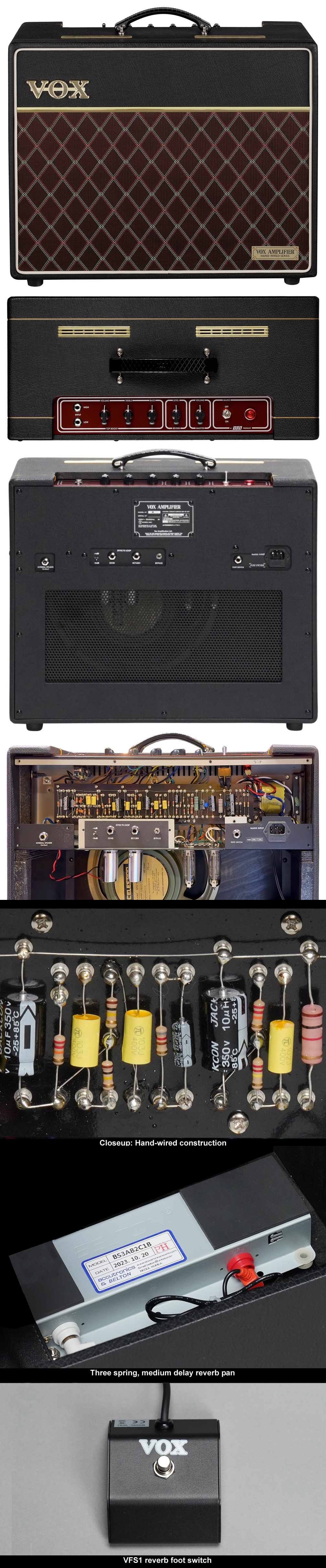
 Vox AC10HWR1 Valve Combo Control Panel Layout
|
|
The AC10HWR1 pays homage to the 1963 JMI (Jennings Musical Industries) Vox AC-10. By blending vintage character with modern circuitry, the hand wired AC10HWR1 bridged the gap between past and present. Let's compare the AC10HWR1 to the original JMI Vox AC-10.
JMI Vox AC-10 (1960-1965)
Debuting in 1960, the JMI Vox AC-10 was a dual-channel, 10-watt guitar amplifier as detailed on Jennings service schematic OS/008 No.3, from September 9, 1960.
Its six tube design included two unconventional tube choices: the ECF82 and the EF86. A 12AX7, an EZ81 rectifier tube, and two EL84 output tubes were also included.
The ECF82 was a dual element triode/pentode tube. The AC10 Normal channel used the triode element of a ECF82 tube for the preamp gain stage. The triode element of the ECF82 had a rather low amplification factor (mu) of 40. As a result, the AC-10 Normal channel lacked gain and drive, making the tone rather bland.
The pentode element of the ECF82 tube was used as the modulator for the tremolo circuit. "Speed" and "Amplitude" (depth) controls adjusted the effect. A single button remote "egg pedal" actuated the tremolo.
The Vibrato (tremolo) channel used one of Dick Denney's favorite tubes, the EF86. Denney's preference for the harmonically rich, high gain EF86 tube was apparent as it was designed into the preamp circuitry of the entire original Vox amp line (AC-2, AC-4, AC-6, AC-10, AC-15 and AC-30).
The 12AX7 served as the phase inverter or "phase splitter," feeding a pair of EL84 output tubes. An EZ81 tube rectified the B+ supply from the mains transformer.
The AC-10 utilized hand-wired point-to-point circuitry and the classic JMI "Contempo" style steel and aluminum chassis.
The amplifier featured two inputs and a volume knob for each channel. Tone shaping was limited to a single passive control that rolled off treble response.
Top Boost Circuit
While active bass and treble controls were not offered in the original AC-10 design, Vox rolled out an optional "Top Boost" circuit for the AC-30 in 1961. This upgrade introduced an additional 12AX7 tube to the AC30 circuit, bringing active bass and treble controls to the Brilliant channel. Unfortunately, this Top Boost kit was not compatible with the AC-10.
"Thin Edge" Cabinet Design
The 1963 AC-10 maintained the iconic Vox "split front" aesthetic introduced in 1961, dividing the face of the cabinet into a vinyl covered upper third and a diamond grille bottom. Except for the top and baffle, the AC-10 was constructed of 7 ply ⅜" (9mm) thick birch plywood, often referred to as the "thin edge" cabinet design. The top and baffle were 13-ply ¾" (18mm) birch plywood. Two brass vents provided ventilation.
While some of the AC-10 amplifiers produced in 1963 were covered in fawn vinyl, many others were covered in the pebbled black Rexine vinyl used on the Vox Continental organ.
Vox AC10HWR1 (2024-)
The AC10HWR1 was a hand wired, ten watt single channel amplifier introduced in 2024. Its four-tube circuit design had two 12AX7 and two EL84 tubes.
The AC10HWR1 had a steel "C" shaped chassis and featured a deep red anodized control panel with five controls: Volume (preamp), Treble, Bass, Reverb Level and Master Volume.
Featuring both preamp and master volume controls, the AC10HWR1 allowed players to get overdriven tones at lower output levels. Additionally, the AC10HWR1 provided ¼" high and low sensitivity input jacks.
Unlike the original AC-10's single passive tone control, the AC10HWR1 adopted the iconic AC-30 Top Boost design with active, individual bass and treble controls. The preamp and Top Boost circuits were powered by one of the two 12AX7 tubes.
The second 12AX7 tube powered the phase inverter circuit in the AC10HWR1. Two cathode biased EL84 tubes powered the 10 watt RMS output stage.
Departing from the original AC-10’s EZ81 rectifier tube, the AC10HWR1 used a custom wound, center-tapped mains transformer coupled to a full-wave, solid state power supply utilizing two 1N4007 diodes. The power supply architecture was tuned to replicate the natural voltage sag and subsequent audio compression of the classic EZ81 rectifier tube.
The AC10HWR1 featured a reverb circuit built around a three-spring BS3AB2C1B Belton/Accutronics tank. The reverb send stage combined a MOSFET transistor with a custom drive transformer while a separate MOSFET driven recovery stage powered the return signal. The pan was enclosed in a vinyl bag screwed to the bottom of the cabinet. Also included was the Vox VFS-1, a remote single-button footswitch for controlling the reverb.
The AC10HWR1 also had a bypassable MOSFET buffered effects loop with a -10/+4db switch.
Like the original JMI Vox AC-10, the AC10HWR1 included a thin edge cabinet. The AC10HWR1 was primarily constructed of 7 ply ⅜" (9mm) thick birch plywood. The top and baffle were 11-ply ⅝" (15mm) birch plywood. The cabinet was covered in pebbled black vinyl, similar to the 1963 JMI Vox AC-10. Two vintage style brass vents provided cooling.
The AC10HWR1 featured a 16 ohm 12" Celestion Greenback speaker, an upgrade over the 10" speaker installed in the 1963 JMI Vox AC-10.
|
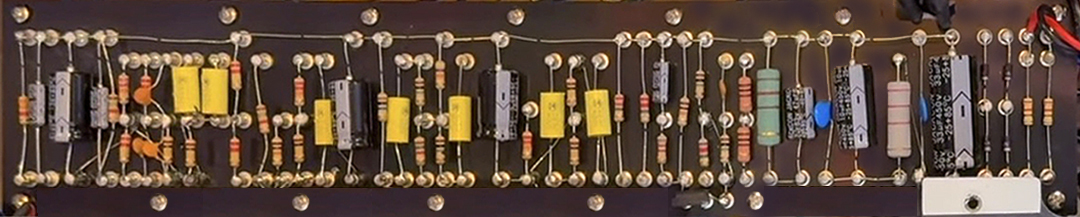
Closeup: Vox AC10HWR1 Hand Wired Turret Strip
VOX AC10HWR1 Valve Combo Specifications
| Output Power: |
|
10 Watts RMS |
|
Speakers: |
|
One 12", 16 ohm Celestion Greenback |
|
Inputs: |
|
One ¼" High and one ¼" Low Jack, FX return |
|
Outputs: |
|
Single ¼" extension speaker jack, FX send |
|
Controls: |
|
Volume (preamp), Bass, Treble, Reverb Level, Master Volume, Mains On/Off |
|
Tubes: |
|
2 - ECC83, 2 - EL84 |
| Included: |
|
VFS1 foot switch for reverb |
| Dimensions: |
|
(W x D x H): ~20.9" x ~9.6" x ~18.7 in |
| Weight: |
|
36.2 lbs. (44.66 lbs in the shipping carton) |
| MSRP (2026): |
|
$2099.99 |
| Street Price: |
|
$1499.99 |
|
3_Footer

Photos and editorial content courtesy Gary Hahlbeck
Any and all material presented herein is protected by Copyright.
© 1998 - 2026 The Vox Showroom, all rights reserved
The images and editorial content in this web site may not be copied or reproduced
in online auction sites such as eBay, Reverb and Craig's List. Sellers may provide a link
to the Vox Showroom web site if they wish to refer to this copyrighted material.
|
URL: https://www.voxshowroom.com/uk/amp/AC10HWR.html
|