Vox Escort 50 Lead Solid State Amp
 |
|
In 1982, Vox distributor Rose-Morris debuted the tube-driven V125 Combo and the solid-state Escort Lead 50. These models, showcased in a color flyer (see bottom left) at that years UK Music Trade Fair, were the last Vox amplifiers manufactured at the Dallas facilities in Shoeburyness, Southend on Sea.
Troubles at Shoeburyness
Led by John Dallas and Ivor Arbiter, Dallas Arbiter was a powerhouse in the 1970s UK music industry, managing brands like the Fuzz Face pedal, Hayman guitars, Carlton drums, and Sound City amps while also serving as the UK’s Fender distributor.
In 1973, the company expanded by acquiring the iconic Vox brand (aka Vox Sound Limited) from Birch-Stolec and began construction of a massive, consolidated manufacturing and warehousing facility for all of its brands in Shoeburyness, Southend-on-Sea, Essex UK.
However, 1974 brought a major shift: Ivor Arbiter departed the firm to launch CBS Arbiter, taking the Fender contract with him. Left with the immense debt from the Shoeburyness construction, John Dallas faced bankruptcy, prompting Ivor Arbiter to return and purchase the company to save it from liquidation.
Shortly thereafter, Fender claimed a conflict of interest in CBS Arbiter's ties to Vox. This led to the sale of the Vox brand in 1978 to Rose-Morris, the UK-based global distributor for Marshall Amplification since 1965. As Rose-Morris didn't have its own factory, Dallas arranged to resume Vox production at Shoeburyness to act as their supplier. Rose-Morris rebranded the company, shortening its name from "Vox Sound Limited" to simply "Vox Limited."
It soon became apparent that the Vox amps manufactured at Shoeburyness failed to meet the construction and packaging standards that Rose Morris had previously established with Marshall. Of particular concern was the substitution of particle board for birch plywood in the construction of the amp cabinetry. Further, the packaging was found to be barely sufficient for domestic transit, much less for international distribution.
Following the 1982 release of the Escort Lead 50 and V125 "Climax" combo, Rose-Morris elected to source a new manufacturer, Audio Factors, to replace the amps coming from the Shoeburyness facility.
The Vox Escort 50 Lead
Introduced in 1982, the Escort 50 Lead served as the final installment in an eight year lineage of "Escort" solid-state amplifiers from Vox. This included the Battery Escort, Battery/Mains Escort, Escort 30, Escort Super-Twin, and the close cousin to the Escort 50 Lead featured on this page, the Escort 50 Bass.
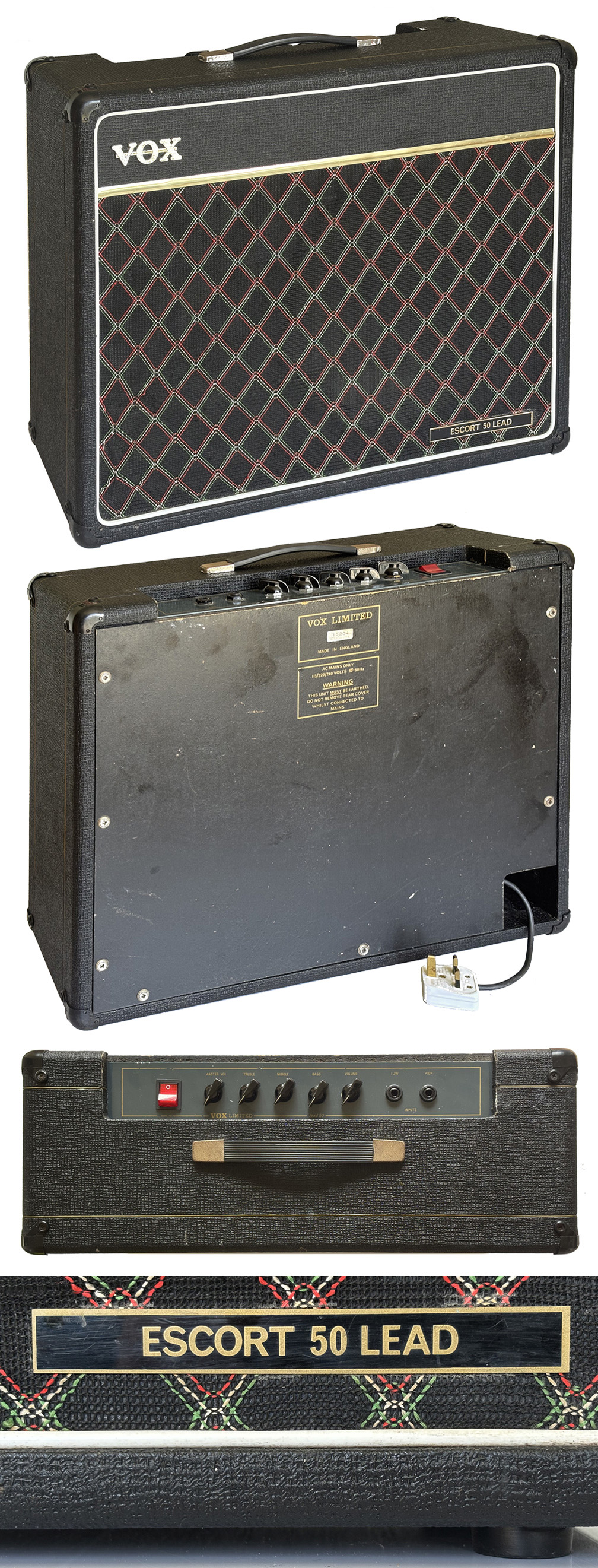
The Escort 50 Lead was a single channel, 50 watt guitar amplifier with a 12" Vox branded Fane 125417 speaker. It's gray control panel was accented with gold silk-screened nomenclature and included dual ¼" Cliff input jacks, a neon illuminated power switch and five controls: volume, bass, middle, treble and master volume.
The Escort 50 Lead amplifier measured 22" wide, 17¾" tall, 8⅛" deep and weighed 32 pounds. While constructed primarily from ¾" particle board, the rear panel was made of ⅛" masonite.
Wrapped in black basketweave Vynide and accented with parallel gold strings, the cabinet showcased the classic Vox "split" front panel with a Vynide covered upper section and black Vox diamond grille below. Gold "T" molding concealed the split between the grille and vynide while white "tadpole" piping followed the perimeter of the front panel. A 2⅞" wide gold plated Vox logo adorned the upper left side of the front panel while an "Escort 50 Lead" nameplate was fastened to the lower right corner of the grille. The cabinet also included eight plastic 2-pin Rean corners, four plastic feet and a strap handle. The masonite back was painted black and had silk-screened product and serial information.
Power Amp and Power Supply Circuits
The Escort 50 Lead employed a "quasi-complementary" 50 watt solid-state power amplifier featuring a push-pull pair of 2N3055 output transistors. This circuit operated on a single 70-volt rail power supply. For a more detailed technical analysis of these circuits, refer to the Escort 50 Lead "Under the Hood" page in the Vox Showroom.
Vox Escort Lead 50 vs Vox Escort Bass 50
Vox debuted the Escort 50 Bass in 1981 followed by the Escort 50 Lead in 1982. Both shared the same cabinet size, 1x12" speaker confguration and 50 watt "quasi-complementary" power amplifier section.
The Escort 50 Lead offered volume and master volume controls alongside a three-band EQ while the Bass model provided a single volume control and a four-band EQ. The Lead version utilized a 12" guitar speaker in a closed-back cabinet; the Bass version featured a 12" speaker specially voiced for bass and a dual-ported rear panel for improved low-end response. The MSRP for either was ~$550 in 1982.
|