 The Vox Riviera I and Riviera II Organs (1967 - 1969)

|
The unmistakable sound of the Vox Continental organ, paired with a Vox amplifier, dominated the pop charts during the early 1960s British music invasion. This distinctive, portable instrument was a staple for British and US acts such as the Beatles, Dave Clark Five, the Animals, Manfred Mann, the Zombies and Paul Revere and the Raiders, both on stage and in the studio.
With the Young Rascals' "Good Lovin'" becoming a huge hit in 1966, showcasing the iconic sound of a Hammond B-3 organ through a Leslie speaker, the Vox Continental's reign faced a serious challenge. Vox responded by introducing the Riviera console organ in 1967 (see official announcement here), designed with features comparable to Hammond. |
Continental Organ Tone Generator Design - 1962
Observing the popularity of Hammond M-3 spinet organs used by beat groups on tour in the UK, JMI engineers Derek Underdown and Les Hill embarked on a project in 1962 to develop a compact, solid-state Vox organ capable of electronically emulating Hammond's tone-wheel sound. This led to introduction of the original "TC" Vox Continental single manual portable organ later that year.
The Vox Continental included twelve solid-state tone generator circuit cards (see image at right), one card for each of the twelve notes in an octave. Every card included 14 germanium transistors. Two of these transistors powered the master oscillator circuit, generating the organ's highest pitches. The other twelve transistors were used in a frequency divider circuit that converted the high pitched output from the master oscillator into the six lower octaves of tones required for proper operation. A complete set of twelve tone generator circuit cards was capable of producing 84 distinct pitched tones.
To counter occasional transistor drift in the frequency divider network, the tone generator cards included a bias control.
Underdown and Hill's original tone generator circuit cards were included in the Vox Riviera I and Riviera II console organs (1967-1969). They were also included in the JMI "TC" single manual Continental in 1962, the JMI dual manual TC/2M Continental II organ in 1965, the V301E single manual Continental (1966), the V303E dual manual Super Continental (1966), the V305 dual manual Continental Baroque (1968) amd the TC/2MP dual manual Continental II with Percussion (1969).
Despite sharing identical electronic circuitry, UK-produced (JMI) and Italian-produced (EME) Vox Continental tone generator cards were not interchangeable due to differences in their connectors.
Drawbars
A key advancement of the Vox Riviera organ was its expanded set of eight harmonic drawbars (16', 8', 5-1/3', 4', 2-2/3', 2', 1-3/5', and 1') for pitch blend, offering far more flexibility than the four drawbars of the single manual Vox Continental (16', 8', 4' and IV rank) or the five drawbars of the Continental II's upper manual (16', 8', 4', II rank and III rank).
A notable distinction between the Vox Riviera and the Hammond organ was the Riviera's omission of the 1-1/3' drawbar voice, resulting in the Riviera having eight drawbars per manual compared to the Hammond's nine.
|
|
 |
The top of the line Vox Riviera II organ had eight harmonic drawbars for both the upper and lower manuals. In contrast, only the upper manual of the Riviera I had eight harmonic drawbars. The lower manual utilized the simpler four harmonic drawbar system from the original single manual Vox Continental.
Beyond the harmonic drawbars that adjusted pitch blend, the Vox Riviera also included three pairs of tone drawbars. Labeled ∿ (Foundation) and M (Reed), these controlled the organ's tonal quality. The Foundation tone was mellow and flute-like while the Reed tone was bright. Each of the organ's sections (upper keyboard, lower keyboard and bass) had its own set of these tone drawbars.
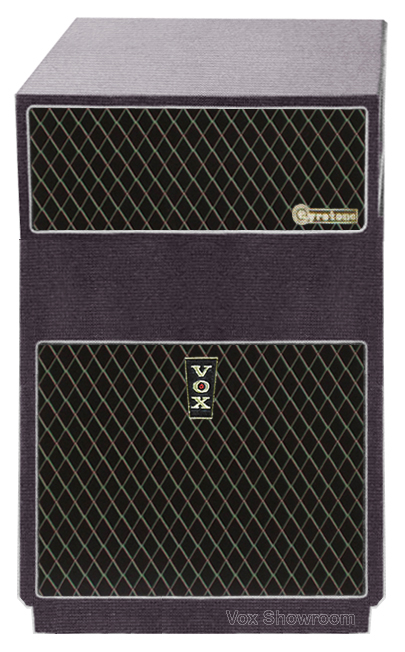
Vox Gyrotone 3 Rotary Speaker
Included with the Vox Riviera 2 Organ |
|
Key Contacts
The Riviera's richer tonal palette demanded more complex wiring. Each key on the organ required eight gold plated contacts to link the tone generators to the eight drawbars. This was a jump from the Continental's four contacts per key and even the Continental II's upper keyboard which used five.
Percussion
The Riviera I and II organs both included an effect in the upper manual called "Percussion" (also known as "Harmonic Percussion"), innovated by Hammond Organ in 1954. This effect boosted the initial attack of a note by creating a short, rapidly fading second or third harmonic overtone while allowing the underlying fundamental tones to sustain. Four tab switches were mounted to the lower right cheek block of the Riviera to control the Percussion effect: 2nd Harmonic, 3rd Harmonic, Long and Soft.
Bass Section
Vox equipped the Riviera II with a dual-octave foot clavier for bass, but the foot clavier for the Riviera I was a smaller, single-octave option, retailing for an additional £26.5 in the February 1969 Vox price list. Both organs included an 8' - 16' switch to change the octave of the bass pedals. They also shared a sustain effect that mimicked the sound of a stand-up bass, with a rotary "Bass Sustain" control on the left upper cheek block to adjust the length of the decay.
Tones 1234
The 1969 "Colossus Incorporated" flyer for Vox organs listed "Tones 1234" as a feature of the Riviera II without further elaboration. Fortunately, the 1969 Vox retail price list sheds more light, revealing that these were upper keyboard presets for piano, harpsichord and string sounds, reminiscent of the 1968 V305 Vox Continental Baroque. |
Vox Gyrotone Speakers
The mid 1960s saw the radio airwaves awash with the dynamic, vibrant sounds of Hammond organs amplified by Leslie Model 122 or 147 rotary speakers. Eager to enter the rotary speaker market, Vox introduced their Gyrotone organ speakers in 1967. Vox bundled the Gyrotone 2 rotary speaker (see photo at right) with the Riviera I organ and the Gyrotone 3 (see photo above left) with the Riviera II.
The Vox Gyrotone speakers differed from Leslie's dual-rotor (bass and treble) Model 122 and 147 by employing only one rotor. In the Gyrotone 2 and 3 systems, a two-speed motor rotated a molded styrofoam rotor over a vertically positioned 12-inch speaker. Enhanced by a high-pass crossover, this rotor projected treble frequencies while two stationary, forward-facing 12-inch speakers produced the bass tones.
The Gyrotone was controlled by two switches on the organ's upper left cheek block. The Main/Gyrotone switch allowed you to choose between just the stationary woofers or the woofers combined with the rotating speaker. The Fast/Slow switch then allowed you to select either the slow "Chorale" speed or the fast "Tremolo" effect. |
|
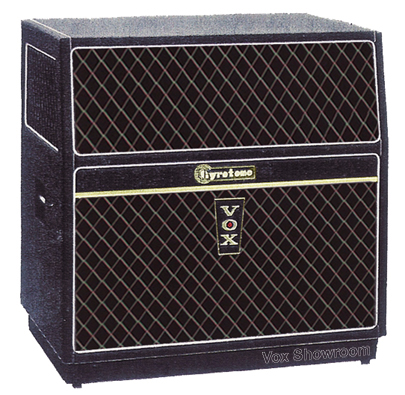
Vox Gyrotone 2 Rotary Speaker
Included with the Vox Riviera 1 Organ |
To power its Gyrotone 2 rotary speaker, the Riviera I organ came equipped with a 50 watt RMS solid-state power amplifier. The Riviera II was more powerful, boasting a 100 watt RMS solid-state amp for its larger Gyrotone 3 rotary speaker. In both models, the amplifier was housed within the organ's base.
When initially announced in 1967, the Vox Riviera may have been designed to include built-in speakers in its base. This is suggested by the diamond grill panels visible on the sides of the console and above the pedal board.
Sustain
The upper keyboard of the Vox Riviera II organ included a "Sustain" effect which allowed notes to continue sounding and gradually fade out even after the keys are released. The Sustain function was particularly useful in simulating tones such as vibes or celesta. It was controlled by two tabs on the upper left cheek block: "Sustain Attack On" and "Sustain Tremulant Med & Long."
Vibrato and Reverb
Both the Riviera 1 and Riviera 2 organs featured vibrato and reverb effects controlled by two tabs on the upper left cheek block. The reverb depth was preset at the factory and could not be adjusted.
Two-Piece Cabinet, Bench
The Vox Riviera 1 and Riviera 2 organs featured a two-piece cabinet design, allowing the 95 pound console top section to be separated from its 97 pound bottom section for ease of transport. According to Vox, separating the console top section from the bottom section was a quick process, taking under a minute and requiring just the twist of a screwdriver. This modular construction offered a significant advantage over traditional Hammond organs, which were typically heavy, single-piece units.
Riviera organ cabinets came in two distinct finishes: either a formal wood veneer or a road worthy black vinyl covering complemented with a classic tangerine (red/orange) vinyl covered lid. The wood veneer cabinets were reportedly supplied to Vox by Thomas Organ.
The Riviera 2 included an organ bench fashioned from chrome plated tubing, reminiscent of the "Z" legs of a Continental organ.
 |
|
Colossus and son
In a 1969 UK magazine ad, Vox boldly christened their top-tier Riviera 2 organ "Colossus," while its less expensive counterpart, the Riviera 1, was playfully called "son of Colossus" and the "mini Riviera."
The advertisement suggested that if the "Colossus" organ's £750 price tag was beyond your means, you might opt for it's "son" at £450 with just a slight reduction in features.
Here's a listing of the differences between the Riviera 1 & 2.
| • |
Drawbars: The lower manual of the Riviera 2 organ had eight harmonic drawbars, the lower manual of the Riviera 1 had four |
| • |
Power Output: The Riviera 2 was rated at 100 watts RMS, the Riviera 1 was rated at 50 watts RMS |
| • |
Gyrotone: The Riviera 2 included the top of the line Gyrotone 3 rotary speaker, the Riviera 1 included the less expensive Gyrotone 2 |
| • |
Sustain: The Riviera 2 included the Sustain and Sustain Tremulant effect, the Riviera 1 did not have these features |
| • |
Bass Pedals: The Riviera 2 included a 25 note set of bass pedals, the Riviera 1 offered a 13 note set of bass pedals as an extra cost option |
| • |
Tones 1234: The Riviera 2 included a set of presets named Tones 1234, the Riviera 1 did not have this feature |
| • |
Bench: The Riviera 2 included a bench, the Riviera 1 did not |
|
|
|
Riviera 1 |
Riviera 2 |
| Complete Organ:.. |
43" W x 39" T x 24" D; 189 lbs |
43" W x 39" T x 24" D; 192 lbs |
| Console Top Section:.. |
43" W x 13" T x 24" D; 92 lbs |
43" W x 13" T x 24" D; 95 lbs |
| Bottom Section:.. |
43" W x 26" T x 21" D; 97 lbs |
43" W x 26" T x 21" D; 97 lbs |
| Speaker:.. |
Gyrotone 2 - 27" W x 26" T x 21" D; 110 lbs |
Gyrotone 3 - 27" W x 41" T x 21" D; 140 lbs |
| Price (1969):.. |
£450 |
£750 |
3_Footer

Photos and editorial content courtesy Gary Hahlbeck
Any and all material presented herein is protected by Copyright.
© 1998 - 2026 The Vox Showroom, all rights reserved
The images and editorial content in this web site may not be copied or reproduced
in online auction sites such as eBay, Reverb and Craig's List. Sellers may provide a link
to the Vox Showroom web site if they wish to refer to this copyrighted material.
|
URL: https://www.voxshowroom.com/uk/organ/riviera.html
|