
VRM-1 "Real McCoy" Reissue Wah-Wah Pedal - 2024
 |
 |
Historical Background
Introduced in February 1967, the "Clyde McCoy" was the original wah pedal, designed and produced by the Vox Division of the Thomas Organ Company, Sepulveda CA. It was named after Clyde McCoy, a 1930's big band leader. McCoy was best known for his artful use of a harmon (wah-wah) mute while playing the trumpet.
The concept of the Clyde McCoy Wah was derived from the MRB ("Midrange Resonance Boost") tone circuitry incorporated in a number of American made Vox amps. The MRB circuit was designed to boost mid range response in these amps at one of three frequencies: 450, 600 or 750 hz. A three-position, panel mounted rotary switch selected the desired boost frequency. Over time, Thomas Organ wanted to improve the MRB circuit by replacing the three-position selector switch with a potentiometer that could offer continuously variable mid-frequency control. The "Clyde McCoy," considered by many to be the holy grail of wah pedals, emerged from the development of this sweepable MRB circuit.
The Clyde McCoy Wah was produced by Vox for less than one year. After that point, Vox ended it's endorsement relationship with McCoy, replacing the Clyde McCoy model with the V846 Vox Wah-Wah. The Clyde McCoy Wah and the V846 actually shared the same two silicon transistor circuit design and schematic. Click here to view the original Thomas Organ schematic for the Vox V846 Wah-Wah pedal.
The V848 Clyde McCoy Wah Pedal - The First "Clyde" Reissue (2002 - 2004)
The soaring prices of the original Clyde McCoy pedal in the vintage marketplace surely indicated just how much demand and admiration there was for them. Developing a premium "Clyde" reissue to offer alongside their traditional V847 model was a brilliant move by Vox, allowing more musicians to experience the iconic sound at an affordable price.
Working in conjunction with Jim Dunlop Manufacturing, Vox introduced the V848 Vox Clyde McCoy reissue in 2002. Rather than utilize the original two transistor circuitry, the V848 reissue was equipped with a completely new, three transistor circuit that included a Fasel inductor. This revised circuit was designed to emulate the sound and "feel" of an authentic 1967 "Clyde" wah pedal.
While the standard Vox V847 wah pedal retailed for $175 in 2002, the V848 Clyde McCoy reissue was offered for $250. |
|
The VRM-1 Real McCoy Wah Pedal - The Second "Clyde" Reissue (2024 - )
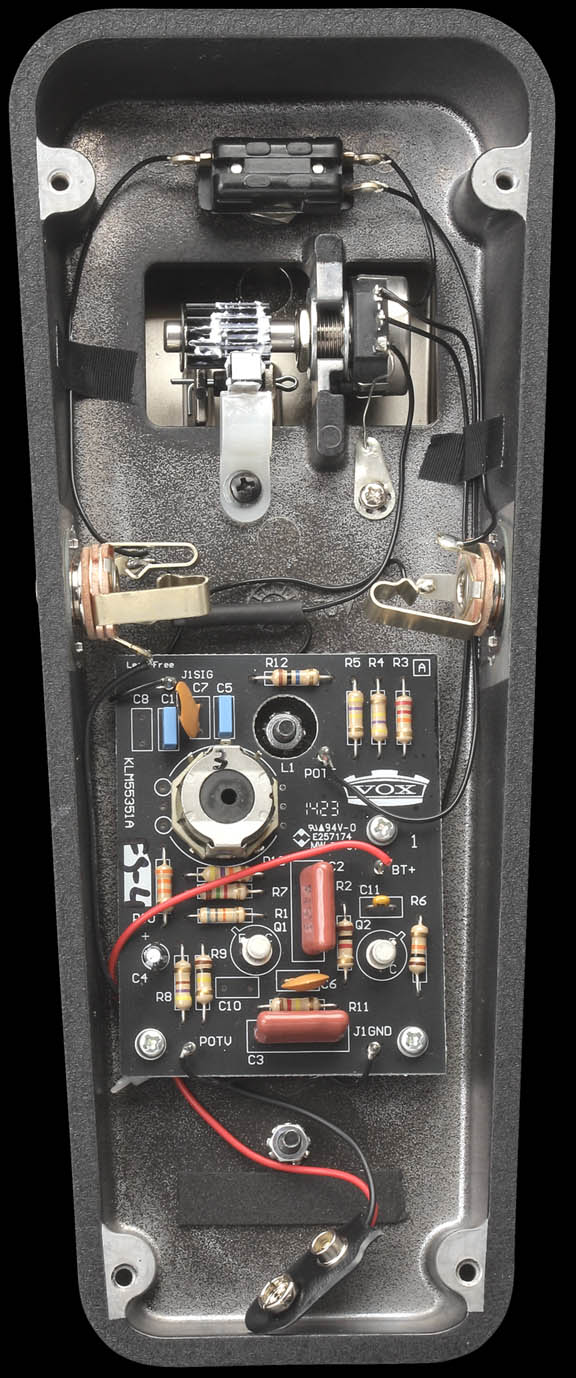
Introduced in 2024, the Vox Real McCoy wah pedal recreated the nasal tone of the original Clyde McCoy by reproducing the original circuit design all the way down to the component level. Vox accomplished this feat by acquiring a mint condition vintage McCoy wah from 1967. This allowed exhaustive A/B testing to be conducted to compare its frequency response against that of other more conventional vintage units. The knowledge gained through this work led to the development of newly designed inductors and 100KΩ potentiometers made specifically for this project. Vox also learned the effect of using the ideal transistors on tone and output.
|
Inductors - The five styles of 500mH ferrite core inductors pictured at right were used in the various versions of Vox wah pedals produced in the 1960s and 1970s by Thomas Organ. Although all of these inductors were rated at 500mh, differences in the design of their ferrite cores led to significant differences in tone caused by a electronic phenomena called "core saturation."
|

Halo Inductor |

"Trash Can"
Inductor |

"Stack of Dimes"
03 Inductor |

Fasel Inductor |

TDK 5103
Inductor |
|
A ferrite core inductor is comprised of a coil of wire wrapped around an iron or "ferrite" core. In simplest terms, core saturation happens when the current in the coil exceeds the ability of the ferrite core to accept any more magnetic flux. This core saturation will create harmonics in the audio output not found in the original signal. These harmonic artifacts affect the tone of the pedal.
While it is possible to find any of the five styles of inductors in a Vox V846 Wah pedal, the original Clyde Mc Coy plus many early Vox V846 Wah pedals utilized the highly revered "Halo" inductor, as shown in photos above. It gets its name from the silver ring-shaped clip that holds the assembly together. Vox wah expert Geoff Teese of RMC Custom Pedals has reported that two versions of the "Halo" inductor were produced for Thomas Organ, each with a different ferrite core and consequentially, somewhat different audio response. When Vox was doing the research in 2023 that led to the creation of the VRM-1 "Real McCoy" wah, their testing confirmed Teese's assertion that there was indeed two versions of the "halo" inductor. One was used consistantly in the "Clyde" pedal, the other in early versions of the Vox V846 wah. Vox recreated both for their 2024 Real McCoy and V846 wah reissues. |
100kΩ Control Potentiometers
A 100KΩ potentiometer controlled the sweep of mid frequencies boosted by Vox wah pedals.
Potentiometers may be designed with either a linear or an audio (logarithmic) taper. Taper is the relationship between the position of the rotating control shaft and the measured resistance of the pot. A linear taper pot will show a proportional increase in electrical resistance as the control shaft is rotated, measuring one half of their total resistance when the control shaft is at mid point. An audio taper pot will exhibit much less than half of rated resistance at the mid point of the control. The electrical resistance of an audio taper pot will increase slowly to the mid point of rotation and then rise rapidly until it reaches the fully clockwise position (see chart at right).
Vox sourced 100KΩ audio taper potentiometers for original Wah-Wah pedals from numerous US suppliers, but the ICAR potentiometer installed in Italian made Vox wah pedals is considered by many to offer superior performance. The ICAR pot had a hybrid design that blended a linear and audio taper. I suspect that the potentiometer Vox developed for the VRM-1 Real McCoy wah was based on this ICAR design. |

|
Transistors
As mentioned earlier, the circuit design for the original Clyde McCoy incorporated two silicon NPN transistors. As Thomas Organ published a service schematic and parts list for their wah wah pedals in 1967, it should have been easy for modern day Vox to determine the correct and original transistor to use in a Clyde reissue pedal. However, this was not the case. In real practice, Vox used at least six different types of NPN transistors in the Clyde pedal. This use of different transistors might have been influenced by availability, cost, or even experimentation to achieve a specific tonal quality.
Thomas Organ used a color coded system to identify their transistors. Thomas Organ offered the "green/yellow" dot transistor (2N3900A) as the recommended replacement in the factory service manual. I have also seen Clyde pedals with "red" or "orange" dot transistors (2N2923) or "yellow" dot transistors (2N2924). Some Clyde wahs came equipped with BC109 "metal can" transistors. Vox also installed IW 9801 or IW 9802 transistors from SCS, an Italian semiconductor manufacturer, in a number of Clyde McCoy pedals.
All of these transistors have a different hfe, or "small signal current gain" value. The greater the hfe value, the greater the maximum gain potential. The 2N2923 has a maximum hfe value of 180. The 2N2924 has a maximum hfe value of 300. The 2N3900A has a maximum hfe of 500 while the BC109 has a maximum hfe of 900. I was unable to determine the maximum hfe level for the SGS IW 9801 or IW 9802 transistors.
Due to its higher gain, many collectors prefer the performance of a vintage Clyde McCoy wah powered by a pair of BC109 "metal can" transistors. This was the transistor chosen by Vox for their 2024 "Real McCoy" wah reissue.
Pricing
The Vox VRM-1 Real McCoy wah retailed at $391.99 but was normally offered at a discount price of $279.99. Vox also offered the VRM-1LTD, a limited edition version of the "Real McCoy" wah that featured a fully chrome plated case. It retailed for $419.99 and was normally discounted to $299.99. |
3_Footer

Photos and editorial content courtesy Gary Hahlbeck
Any and all material presented herein is protected by Copyright.
© 1998 - 2026 The Vox Showroom, all rights reserved
The images and editorial content in this web site may not be copied or reproduced
in online auction sites such as eBay, Reverb and Craig's List. Sellers may provide a link
to the Vox Showroom web site if they wish to refer to this copyrighted material.
|
URL: https://www.voxshowroom.com/us/misc/VRM-1.html
|