Eager to break into the fuzz market, JMI struck a deal with the Musical Exchange to source Tone Bender pedals, allowing Jennings to distribute them to Vox dealers throughout the UK and Europe. An original copy of a 1968 purchase order from JMI to the Musical Exchange for Tone Benders can be seen at this link. The American Vox distributor, Thomas Organ of Sepulveda CA established a partnership with Italian manufacturer JEN to create a similar fuzz pedal for the U.S. market, the V828 Vox Tone Bender (shown above at left).
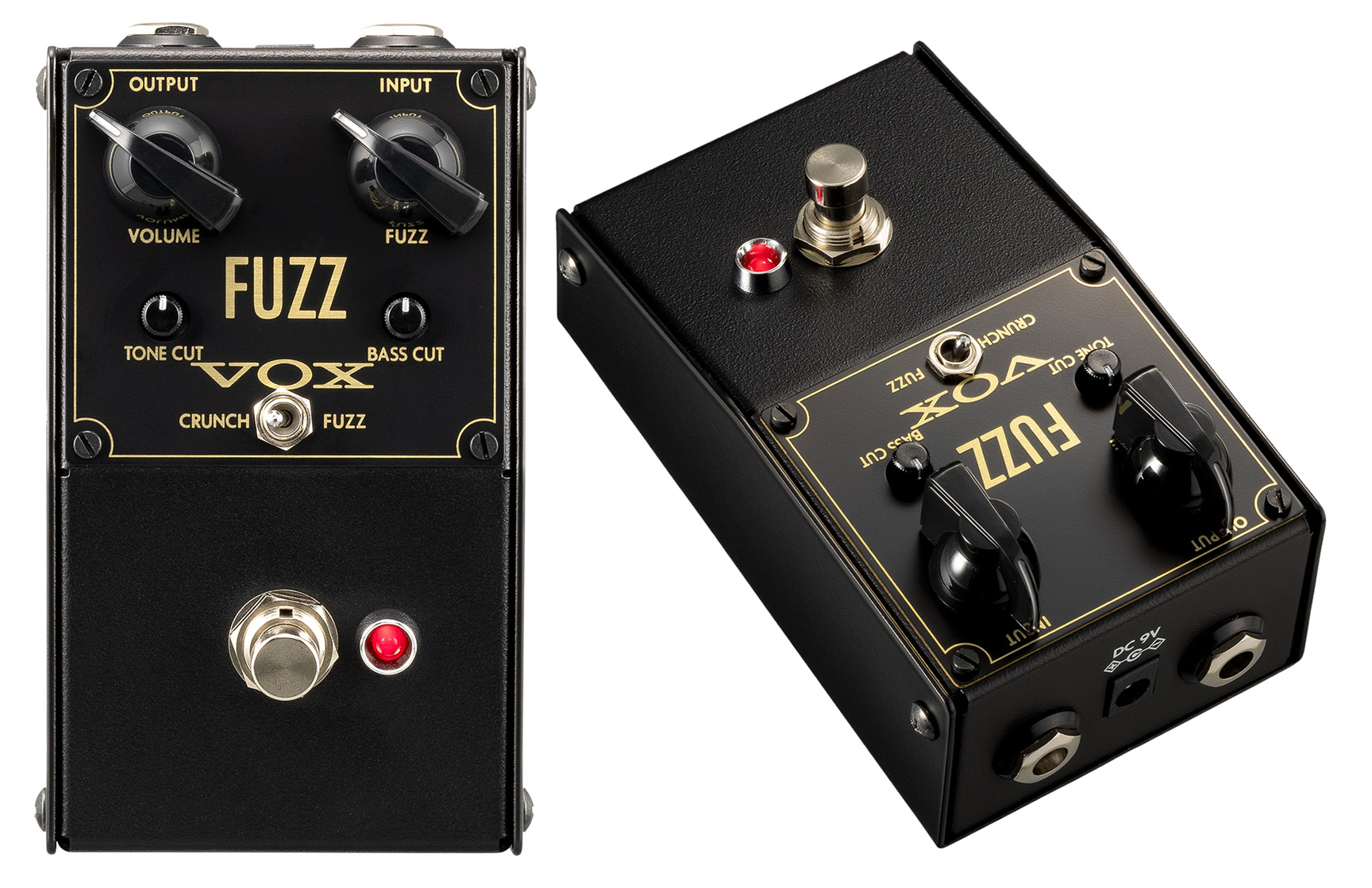
Sola Sound's Tone Bender fuzz pedal evolved through three iterations in the mid-1960s. The first was the Tone Bender MkI from 1965 featuring a circuit with three germanium transistors. The MkI was housed in a stamped steel, wedge-shaped case. The Tone Bender MkII "Professional" was introduced in late 1966 with an updated three germanium transistor circuit that offered increased gain and sustain. The MkII Professional had a cast aluminum case. A transitional version, the Tone Bender Mk1.5 appeared between the MkI and MkII. Unlike its predecessor and successor, the Mk1.5 had a simplified, two-germanium transistor circuit. It also introduced the cast aluminum case. This tone and response of the Mk1.5 Tone Bender served as the benchmark for the VFZ-1 Fuzz introduced by Vox in 2026.
Germanium vs Silicon Transistors
At the heart of the Mk 1.5 Tone Bender were a pair of Mallory OC75 germanium transistors. Germaniums are legendary for their warm, non-linear response, but they were far from perfect, frequently falling victim to heat related failures and exhibiting inconsistent performance from one pedal to the next. Silicon transistors eventually arrived in the middle sixties to address these technical flaws. Still, for tone purists, the original germanium circuits possess the mojo that modern silicon transistors can't quite replicate.
Development of the Reissue VFZ-1 Vox Fuzz
To avoid the unreliability and scarcity of good quality germanium transistors, the Vox engineering team chose to innovate rather than simply clone the 1966 Mk1.5 Tone Bender. Their goal was to capture the pedal's signature warm, non-linear vintage response while utilizing the stability and consistency of silicon transistors.
After months of modeling original Mk1.5 Tone Bender pedals and studying their behavior, Vox announced that they had developed a unique method to replicate that classic germanium character. By using a pair of silicon transistors independently biased at precisely calculated operating voltages, Vox successfully bridged the gap between authentic vintage tone and modern bulletproof, low noise performance.
Vox VFZ-1 Fuzz Controls
The Vox VFZ-1 Fuzz had five controls: Volume, Fuzz, Tone Cut, Bass Cut and a Crunch/Fuzz mini toggle switch. - The Volume control adjusted the overall output level of the fuzz effect
- The Fuzz control adjusted the intensity of the fuzz effect
- The Tone Cut control reduced the treble response of the fuzz effect
- The Bass Cut control reduced the bass response of the fuzz effect
- The "Crunch-Fuzz" switch toggled between reduced fuzz gain (Crunch) and original fuzz gain (Fuzz)
A red LED lamp indicated the fuzz effect was activated.
The Vox VFZ-1 Fuzz retailed for $209.99 USD when introduced in January 2026 with a typical "street" price of $149.99 USD. Click here to download the Vox VFZ-1 Fuzz owner's manual. |