 Vox AC15HWR1 1x12" Combo Amplifier (2024 - )
Vox AC15HWR1X 1x12" Combo Amplifier (2024 - )
Vox AC15HWR1 1x12" Combo Amplifier (2024 - )
Vox AC15HWR1X 1x12" Combo Amplifier (2024 - )
 Vox AC15HWR1 Control Panel Layout


Vox AC15HWR1 Tube Layout - See Chart Above
| V1A |
12AX7 |
Normal Channel Preamp |
| V1B |
12AX7 |
Top Boost Channel Preamp |
| V2 |
12AX7 |
Top Boost Tone Controls |
| V3 |
12AX7 |
Phase Inverter |
| V4A |
12AX7 |
Reverb Buffer |
| V4B |
12AX7 |
Reverb Return Circuit |
| V5 |
12AT7 |
Reverb Drive Circuit |
| V6 - V7 |
EL84 |
Power Amplifier |
| V8 |
GZ34 |
Tube Rectifier |
|
|
|
Vox introduced the point-to-point, hand-wired HWR Series at the 2024 Winter NAMM show in Anaheim, California. The HWR models replaced the AC4HW, AC15HW, and AC30HW hand-wired amps offered by Vox since the early 2010s.
The HWR Series included four combo configurations: the single channel AC4HWR1 (4W, 1x12"), single channel AC10HWR1 (10W, 1x12"), dual channel AC15HWR1 (15W, 1x12"), dual channel AC30HWR2 (30W, 2x12") and one 30 watt head, the dual channel AC30HWRH. Vox loaded the 4 watt and 10 watt models with Celestion G12 Greenbacks, while the 15-watt and 30-watt combos offered a choice of Celestion G12 Greenback or Blue Alnico speakers.
Reissue vs Tribute Amplifiers
A "reissue" amplifier aims to create an exact, partt-for-part replica of a specific model from the past. In contrast, a "tribute" amplifier blends classic, retro circuitry essential for vintage tone with modern features and design.
The 2024 Vox AC15HWR1 and AC15HWR1X tribute amplifiers merge 1963 vintage design with modern features to create a completely redesigned AC-15.
Back to the Beginning
The original circuit design for the 1960-–66 JMI Vox AC-15 is captured on schematic "OA/031 'Vox' AC.15 Amplifier Circuit No 3." dated 4/29/1960. It breaks the original amp down into four core circuits: the "Normal" and "Vib-Trem" channels, the phase inverter/power amp stage, and the power supply. This schematic diagram will guide my comparison between the original 1960 JMI architecture and the modern AC15HWR1 tribute amplifier.
Normal Channel
The design of the original, 60s era Vox AC-15 Normal channel preamp integrated an EF86 pentode tube rather than the more common dual triode 12AX7. A personal favorite of chief Vox engineer Dick Denney, the EF86 was included in the preamp stages of all of the early JMI Vox amp models, including the AC-4, AC-10, AC-15, and AC-30/4.
While a standard 12AX7 provides a theoretical amplification factor (μ) of 100, the EF86 pentode yields a significantly higher value of 185. This elevated gain drives the power amp section harder to deliver superior output and enhanced harmonic overtones.
Unfortunately, the EF86 pentode introduced its own set of specific engineering challenges. The intricate internal structure and high gain of the EF86 made the tube highly susceptible to microphonics and an elevated noise floor. For these reasons, Vox chose to not include the EF86 in the design of the AC15HWR1 or AC15HWR1X.
To replicate the EF86's high-gain characteristics, Vox designed a hybrid solution for the AC15HWR1/1X tribute amps. Engaging the control panel mounted "Boost" switch added an LND150 FET transistor to the output stage of the Normal channel's 12AX7 (V1A) tube, providing the extra gain needed to mirror EF86 response.
The Normal channel of the original JMI Vox AC-15 also featured a "Brilliance" switch. This panel mounted switch introduced a 250pF capacitor into the signal path between the EF86 tube and the Normal channel's volume control. Once engaged, this capacitor acted as a high-pass filter, introducing a steep roll off in bass frequencies while allowing the treble frequencies to pass through unaffected.
The AC15HW1 and AC15HWR1X tribute amplifiers both included this Brilliance circuit.
Vib/Trem Channel
The second, or "Vib/Trem" channel of the original JMI Vox AC-15 featured a modulation effect that added either tremolo (amplitude modulation) or vibrato (frequency modulation) to the audio signal. In an interview with Guitar Player magazine, Vox lead engineer Dick Denney admitted that he "reverse engineered" the Vib/Trem circuit from a Wurlitzer home console organ.
The Vib/Trem circuit was highly complex. It required an extensive array of electronic components—comprising nearly half of the entire AC-15 circuit —to create a modulation effect with limited day-to-day usefulness. For this reason, the Vib/Trem circuit was not included in the AC15HWR1/1X tribute amplifiers.
Top Boost
Developed by Vox in 1961, Top Boost was a supplemental 12AX7 powered circuit designed to expand the tonal capabilities of the AC-30/6. It equipped the Brilliant channel with active bass and treble controls. The circuit was initially offered only as a retrofit kit but over time became a factory-installed feature.
While Top Boost was never offered in AC15 amps produced during the 1960's, Vox included the Top Boost circuit in the second channel of the AC15HWR1 and AC15HWR1X tribute amps. The Top Boost circuit was powered by a 12AX7 (V2) tube.
All Tube Spring Reverb
The AC15HWR1 and 1X also included an all-tube Accutronics/Belton spring reverb circuit, an option JMI had not offered in the original AC-15. The reverb effect was applied to the inputs of both channels.
The drive side of the reverb circuit utilized a 12AT7 (V5) tube and a transformer. One half of a 12AX7 (V4B) tube provided reverb recovery. Controls for reverb level and reverb tone plus a VFS1 remote footswitch were included.
Phase Inverter and Power Amp Stages
Like the original JMI AC-15, the AC15HWR1 and AC15HWR1X used a 12AX7 (V3) tube in a long tail pair phase inverter circuit. This circuit divides the preamp signal into two signals that are mirror images of each other. These out of phase signals were sent to each half of a "push-pull," cathode biased EL84 power amplifier circuit. One half of the phase inverter supplied the signal to the "positive" side of the power amp, the other half of the phase inverter supplied the signal to the "negative" side of the power amp.
The phase inverter does much more than split the preamp signal into positive and negative parts; it plays a major role in shaping the overall tone of the AC-15. Cranking the volume pushes both the preamp and phase inverter tubes into saturation. The interaction between these overdriven tubes creates the rich, layered harmonics of the classic AC-15.
The "Tone Cut" circuit straddled the out of phase audio signals from the phase inverter with a 250k "Tone Cut" potentiometer (VR7) and a .0047 uF capacitor (C4). Rotating the 250k control reduced the resistance in VR7, allowing the opposing signals from the phase inverter to combine. Were it not for capacitor C4, these opposing signals would completely cancel each other out. Capacitor C4 only allowed the treble frequencies to pass into VR7, in turn "cutting" only them.
The 15-watt power amplifier stage featured a pair of EL84 tubes running in a cathode-biased, zero-negative-feedback configuration.
Power Supply
The original, 60s era JMI AC-15 had a mains (power) transformer that offered the choice between five AC wall voltages: 115V, 165V, 205V, 225V, and 245V. However, the AC15HW1 and 1X could not provide this offer this feature due to modern electrical safety standards. Instead, these amplifiers were built to operate only at the specific voltage of the country where purchased (100V, 120V, or 225–240V). Should a mains voltage change become necessary, the appropriate mains transformer must be purchased from Vox and installed in the amplifier.
A tube rectifier was used in the B+ DC supply of both the original AC-15 and the AC15HWR1 tribute amps. The original AC-15 used an EZ81 tube, but the AC15HWR1 upgraded to the larger GZ34 tube from the AC-30. The GZ34 tube offered superior |
performance by keeping the B+ voltage stable under heavy loads and by increasing the maximum available current. This allowed the AC15HWR1 and 1/X to have a wider, punchier dynamic range.
The original AC-15 and the AC15HWR1 tribute amps both used a "capacitive pi" circuit to smooth out the AC ripple in the B+ power supply. This setup relied on a 10H choke, a reservoir capacitor, and a filter capacitor. The choke was wired in line with the raw, pulsed DC coming from the rectifier tube. To finish the "pi" shape, the positive end of the reservoir capacitor connected to the side of the choke nearer the rectifier tube while the positive end of the filter capacitor connected to the far side of the choke. The other ends of the capacitors went to ground.
Thin Edge Enclosure
JMI did not build its own Vox amplifier cabinets. Instead, the company outsourced enclosure production to several external contractors, with the P.A. Glock Company and Gla-Rev supplying the majority.
P.A. Glock traditionally constructed Vox cabinets from 13-ply, 18mm (¾") Baltic birch plywood. In contrast, Gla-Rev utilized thinner 7-ply, 9mm (⅜") and 9-ply, 12mm (½") panels. This shift to lighter materials in these "thin edge" enclosures cut material costs, reduced the amplifier's weight, and minimized shipping fees. These "thin edge" cabinets also played a role in defining the signature tone of the AC-15.
Vox switched to "thin edge" AC-15 enclosures in 1961. These baltic birch cabinets utilized an 18mm (¾") baffle and top panel and 9mm (⅜") sides, bottom and back panels.
In the fall of 1963, Vox transitioned away from its signature 1961 fawn amp covering. The brand briefly covered their amps in the smooth black vinyl used on Continental organs and introduced Vox logo handles. This era also marked the final appearance of brass vents.
The 2024 AC15HWR amplifiers were equipped with original style "thin edge" enclosures that closely modeled the cosmetic specifications from October 1963, including smooth black vinyl, Vox logo handles and brass vents.
Pedalboard Ready FX Loop
The AC15HWR series also included a fully bypassable MOSFET transistor buffered effects loop with -10/+4db switch.
|
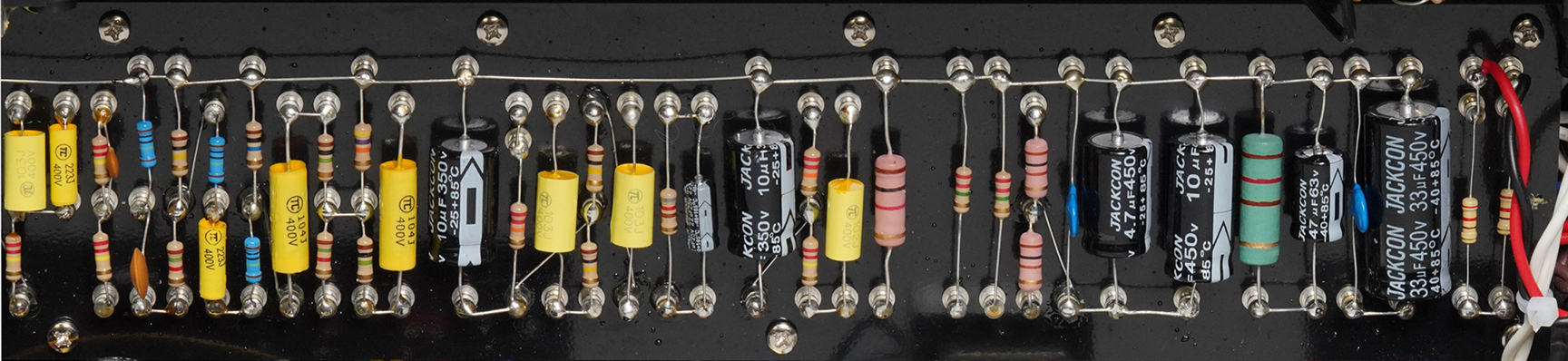 Closer view of hand wired construction
VOX AC15HWR1/1X Valve Combo Specifications
| Output Power: |
|
15 Watts RMS |
Speakers:
|
|
AC15HW1X - One 16Ω Celestion Blue Alnico
AC15HW1 - One 16Ω Celestion Greenback |
Channels and Inputs:
|
|
Ch.1 - Normal Channel, Hi & Lo Inputs
Ch.2 - Top Boost Channel, Hi & Lo Inputs |
|
Outputs: |
|
Single ¼" extension speaker jack, FX send |
|
Controls: |
|
Channel 1: Volume, Boost Switch, Bright switch
Channel 2: Volume, Bass, Treble
Master Controls: Reverb Level, Reverb Tone, Tone Cut, Master Volume |
|
Tubes: |
|
4 - ECC83, 1 - 12AT7, 2 - EL84, 1- GZ34 |
| Included: |
|
VFS1 foot switch for reverb |
| Dimensions: |
|
(W x D x H): 23.27" x 10.35" x 22.32" |
| Weight: |
|
50.04 lbs. |
Street Price (2026):
|
|
AC15HW1 : $1799.99
AC15HW1X: $1999.99 |
| Origin : |
|
Vietnam
|
|
3_Footer

Photos and editorial content courtesy Gary Hahlbeck
Any and all material presented herein is protected by Copyright.
© 1998 - 2026 The Vox Showroom, all rights reserved
The images and editorial content in this web site may not be copied or reproduced
in online auction sites such as eBay, Reverb and Craig's List. Sellers may provide a link
to the Vox Showroom web site if they wish to refer to this copyrighted material.
|
URL: https://www.voxshowroom.com/uk/amp/AC15HWR.html
|