Vox Continental 71 Organ, EME (Italian) Production
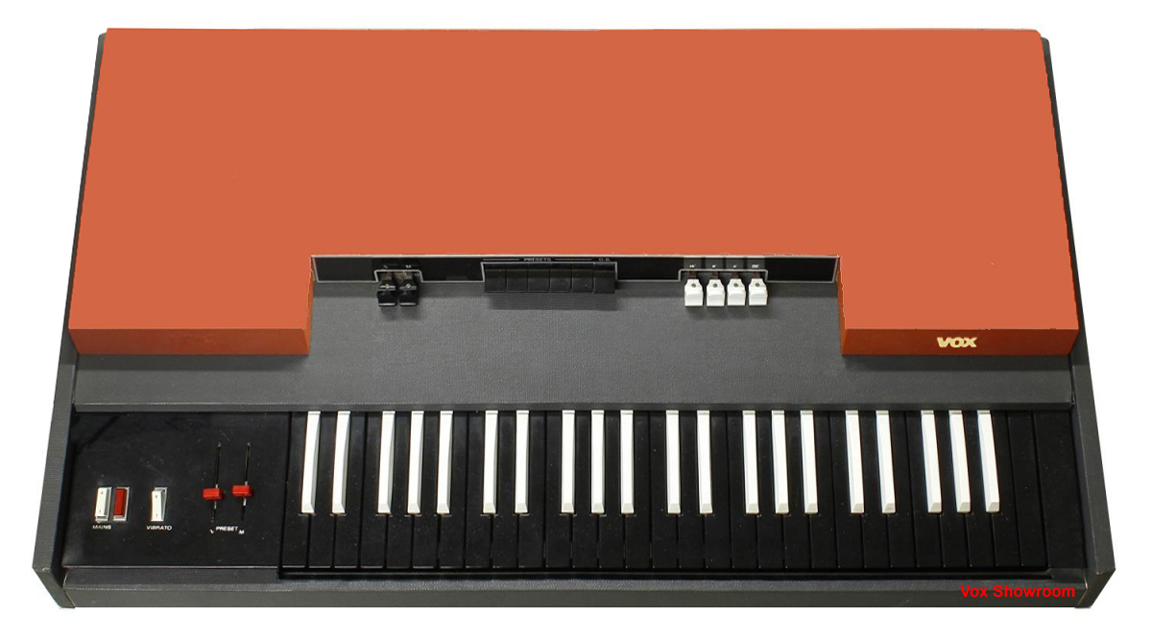
The Continental 71 was a 49 note, single manual portable organ produced for Vox by EME in Italy and introduced in 1971. It was the final version of the original single manual Vox Continental organ. The Continental 71 incorporated several design innovations developed in 1970 for the dual manual Continental 300 organ that included redesigned tone generator cards and the inclusion of preset tone tabs. It was not included in the 1971 Vox Sound Limited product catalog.
Continental 71 Tone Generator Card
Tone Generator Circuit Redesign Prior to 1970, all Vox Continental organs shared a tone generator circuit designed in 1962 by Vox engineers Derek Underdown and Les Hill. The system relied on 12 discrete, transistorized tone generator cards, one dedicated to each note of the musical scale. Every individual card utilized a 14 transistor layout split into two distinct stages:
The Master Oscillator: Powered by two transistors, several capacitors, and an adjustable tuning coil, this stage generated the highest tuned pitches for the instrument.
The Frequency Divider Circuit: This stage accepted the high pitched signal from the master oscillator. Using six pairs of transistors (12 total), it sequentially divided the frequency of the master oscillator down to produce six lower octaves of that specific note, or in total, seven octaves of notes per card when including the original signal from the master oscillator. Each tone generator featured a small potentiometer mounted on the rear of the card to allow technicians to manually adjust the bias voltage, ensuring the frequency dividers stayed locked in sync and functioned properly.
These original tone generators had an inherent issue caused by the germanium transistors included in their circuits. Germanium transistors were notoriously unstable and prone to premature failures. When Underdown and Hill developed the circuits for the Vox Continental organ in 1962, they had little choice but to use germanium transistors, it was the prevalent technology at the time.
The introduction of more dependable silicon transistors in the mid-1960s offered a solution to these problems. However, Vox continued production of the original Continental organ design until 1970 at which point the needed change was finally made: the elimination of the germanium transistors.
Please refer to the image of the Continental 71 generator card above. The master oscillator was now powered by a pair of SFT714R NPN silicon transistors. Additionally, its frequency divider circuit now incorporated a SAJ110 silicon based integrated circuit (IC), a relatively new invention in 1970. This single IC replaced all twelve transistors in the original frequency divider circuit, streamlining the design considerably. As the oscillator and divider circuits required different operating voltages, the Continental 71 power supply included dedicated supply taps for each of these stages. Due to the stability of these new tone generators, bias pots were no longer required to correct for drift in the frequency divider circuit.
Vox also ncluded this redesigned tone generator design in the Italian (EME) version of the Continental 300 organ.
Drawbars and Preset Tone Tabs Most of the Continental 71 voicing controls were situated in a recessed cove in the organ's orange lid. Positioned to the right were four drawbars with white tips to control the volume blend for the 16', 8', 4', and IV pitch registers. Two drawbars with black tips located to the left adjusted overall timbre. The left or "~" drawbar delivered a mellow, flute-like voicing, while the right or "M" drawbar provided a bright, reed-like tone.
A row of six tone tabs were located between the pitch and timbre drawbars. Activating any tab switch from position one through five engaged factory-configured preset pitch combinations and deactivated manual drawbar control. Two red slider "Preset" controls located on the left cheek block offered control over the flute ("~") and reed ("M") voicing of presets 1-5. Activating the sixth (or D.B.) switch returned the instrument to manual drawbar control.
"Box Top" Lid The Vox Continental 71 featured a top covered in orange Rexine vinyl that was a uniform 1½" tall on all sides, similar to the design of the rare and original 1962 "box top" Continental. Additionally, the edge of the top facing the player was vertical rather than angled. In contrast, the tops of most production Continental organs tapered from 1¼" tall at the keyboard to ½ " tall at the front of the organ while the edge of the top facing the player was slanted, not vertical.
Logos The Continental 71 utilized the same product logos as the 60s era single-manual Continental: a gold plated injection molded plastic logo on the orange lid and an aluminum "Vox Continental" plate on the front face of the organ.
"Z" Leg Stand The Continental 71 was the final Vox organ model to include the traditional chrome plated "Z" leg stand and carrying case.
My thanks to Stephen Walsh for providing some of the images shown on this page.
Vox Continental 71 video used with the permission of the author, Andrej Maver
The images and editorial content in this web site may not be copied or reproduced
in online auction sites such as eBay, Reverb and Craig's List. Sellers may provide a link
to the Vox Showroom web site if they wish to refer to this copyrighted material.

 Continental 71 Tone Generator Card

