 The Continental 300 Organ - 1970 - 1972

Vox introduced the UK-produced Continental 300 (shown above left) on page 10 of its September 1970 catalog. This model essentially upgraded the list of features suggested for the 1969 Vox Continental II with Percussion organ by adding five preset tone control tabs, spring reverb, and a redesigned tone generator circuit that incorporated integrated circuits. The UK produced Continental 300 featured a lid covered in gray vinyl, a distinct change from the reddish-orange vinyl seen on the lids of earlier Vox organs.
The 1971 Vox catalog unveiled a new iteration of the Continental 300 (shown above right), this time manufactured in Italy by EME (Electtronica Musicale Europea). While this Italian version mirrored the features of its UK produced counterpart, it sported a restyled lid covered in the classic reddish-orange vinyl.
|
|
 |
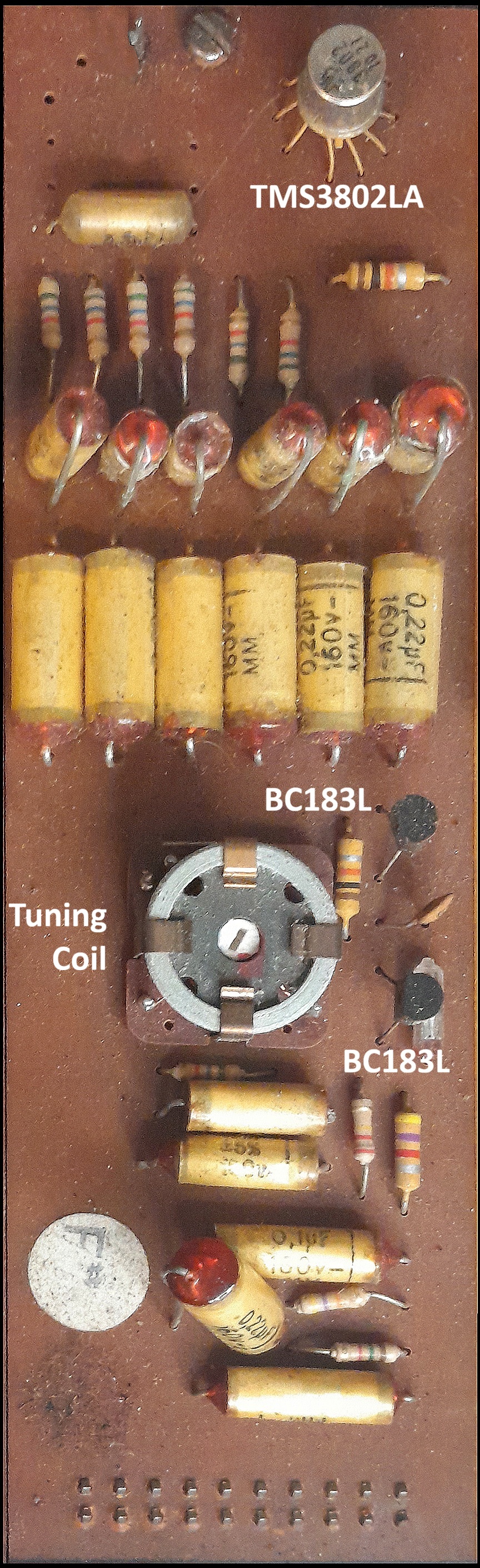 UK Continental 300 Tone Generator
|
|
Tone Generator Circuit Redesign
Prior to 1970, all Vox Continental organs manufactured in England or Italy shared a tone generator circuit designed in 1962 by Vox engineers Derek Underdown and Les Hill. The system relied on 12 discrete, transistorized tone generator cards, one dedicated to each note of the musical scale. Every individual card utilized a 14 transistor layout split into two distinct stages:
- The Master Oscillator: Powered by two transistors, several capacitors, and an adjustable tuning coil, this stage generated the highest tuned pitches for the instrument.
- The Frequency Divider Circuit: This stage accepted the high pitched output from the master oscillator. Using six pairs of transistors (12 total), it sequentially divided the frequency of the master oscillator down to produce six lower octaves of that specific note, or in total, seven octaves of notes per card when including the original signal from the master oscillator. Each tone generator featured a small potentiometer mounted on the rear of the card to allow technicians to manually adjust the bias voltage, ensuring the frequency dividers stayed locked in sync and functioned properly.
These original tone generators had an inherent issue caused by the germanium transistors included in their circuits. Germanium transistors were notoriously unstable and prone to premature failures. When Underdown and Hill developed the circuits for the Vox Continental organ in 1962, they had no choice but to use germanium transistors, it was all that was available at the time.
The introduction of more dependable silicon transistors in the mid-1960s offered a solution to these problems. However, Vox continued production of the original Continental organ circuit in the UK and Italy until 1970 at which point the needed change was finally made: the elimination of the germanium transistors.
The master oscillator was now powered by a pair of BC183L NPN silicon transistors or equivalent. Additionally, its frequency divider circuit now incorporated a silicon based integrated circuit (IC), a relatively new invention in 1970. This single IC replaced all twelve transistors in the original frequency divider circuit, streamlining the design considerably. The UK Continental 300 frequency divider design used a 10 pin TMS3802LA integrated circuit housed in a round metal can while the Italian EME Continental 300 substituted a 14 pin SAJ100 dual-inline IC. Due to the stability of these new tone generators, bias pots were no longer required to correct for drift in the frequency divider circuit.
Vox included these redesigned tone generators in the Continental 300 (1970), Continental 301 (1970), Riviera 400 (1970) and Continental 71 (1971) organs.
|
Drawbars
Hammond Organ introduced drawbars as an innovative way to control an electronic organ's voicing. Nine drawbars were assigned to each manual. The front of each drawbar was marked with a footage designation such as 8', 4', or 2'. This number is pipe organ terminology for the length of pipe required to create a particular pitch. Further, the numbers '1' through '8' on the spine of the drawbar indicated the degree of volume, ranging from soft to loud.
The Continental 300 adopted a drawbar system that drew heavily from Hammond's design. It's lower keyboard featured four white drawbars labeled 8', 4', 2', and IV (a mixture of four overtones). Its upper keyboard moved even closer to the Hammond sound architecture by adding a fifth drawbar. The white drawbars in the upper manual of the Continental 300 were labeled 16', 8', 4', II (a mixture of two overtones), and III (a mixture of three overtones). The drawbars enabled the organist to blend the volumes of the various pitched tones. |
|
 |
Beyond the white drawbars that adjusted pitch blend, the Continental 300 also included three pairs of tone drawbars. Labeled ∿ (Flute) and M (Reed), these controlled the organ's tonal quality. The Flute tone was mellow while the Reed tone was bright. Each of the organ's sections (upper keyboard, lower keyboard and bass) had its own set of these dark red or black tone drawbars.
 |
|
Percussion
The Continental 300 included an effect in the upper manual named "Percussion" (also known as "Harmonic Percussion"), innovated by Hammond Organ in 1954. This effect boosted the initial attack of a note by creating a short, rapidly fading second or third harmonic overtone while allowing the underlying fundamental tones to sustain. The Continental 300 percussion circuit expanded the harmonic choices to three: 8', 4' or a mixture of 5-1/3' and 1-3/5' overtones. These harmonics could be selected individually or in any combination. A "Short/Long" tab controlled the harmonic decay rate. |
Presets
In addition to its drawbars, the Continental 300 also featured five quick access preset organ tones controlled by switches on the left side of the organ lid. While the switches themselves weren't labeled, the owner's manual identified these presets as "Vox," "Mood," "Club," "Church," and "Jazz." A sixth switch, labeled "DB," allowed the organist to return to the drawbar controlled voicing.
Bass Switch
Located on the cheek block to the left of the upper keyboard, the Bass rocker switch on the Continental 300 allowed players to toggle between an 8' tone or a combination of 8' and 16' tones in the Bass section. These bass tones could be routed either to the bottom octave of the lower keyboard or to an optional thirteen note foot pedal board.
Bass Sustain
The Continental 300's Bass Sustain circuit mimicked the attack and decay of a stand-up bass. The Bass Sustain control adjusted the length of the decay. The UK version of the Continental 300 had a rotary knob for its variable Bass Sustain circuit, the Italian model used a slider.
Vibrato
Located on the upper left cheek block, this switch enabled the vibrato effect. |
|
 |
|
 |
|
Reverb
The Continental 300 featured a spring reverb circuit.
The UK-made Continental 300 used a rotary knob on the upper manual cheek block to control reverb depth. The Italian 300 featured both a slider for reverb depth and a rocker switch to turn the effect on or off.
When Vox added reverb to the Continental 300, an unforeseen problem emerged with the traditional "Z" leg stand. The "Z" stand's inherent "bounce," exacerbated by the Continental 300's considerable 100-pound weight, could cause the reverb springs to create a thunderous crash through an external amplifier.
A New Stand
Initially, Vox tried to fix the bouncy "Z" leg stand by adding an extra vertical support bar to each "Z" leg but this appeared to be a short-term solution. Vox introduced a new, four-post organ stand in 1971 that resolved the stability issue and even provided a tilt adjustment for the keyboard (see photo at left). |
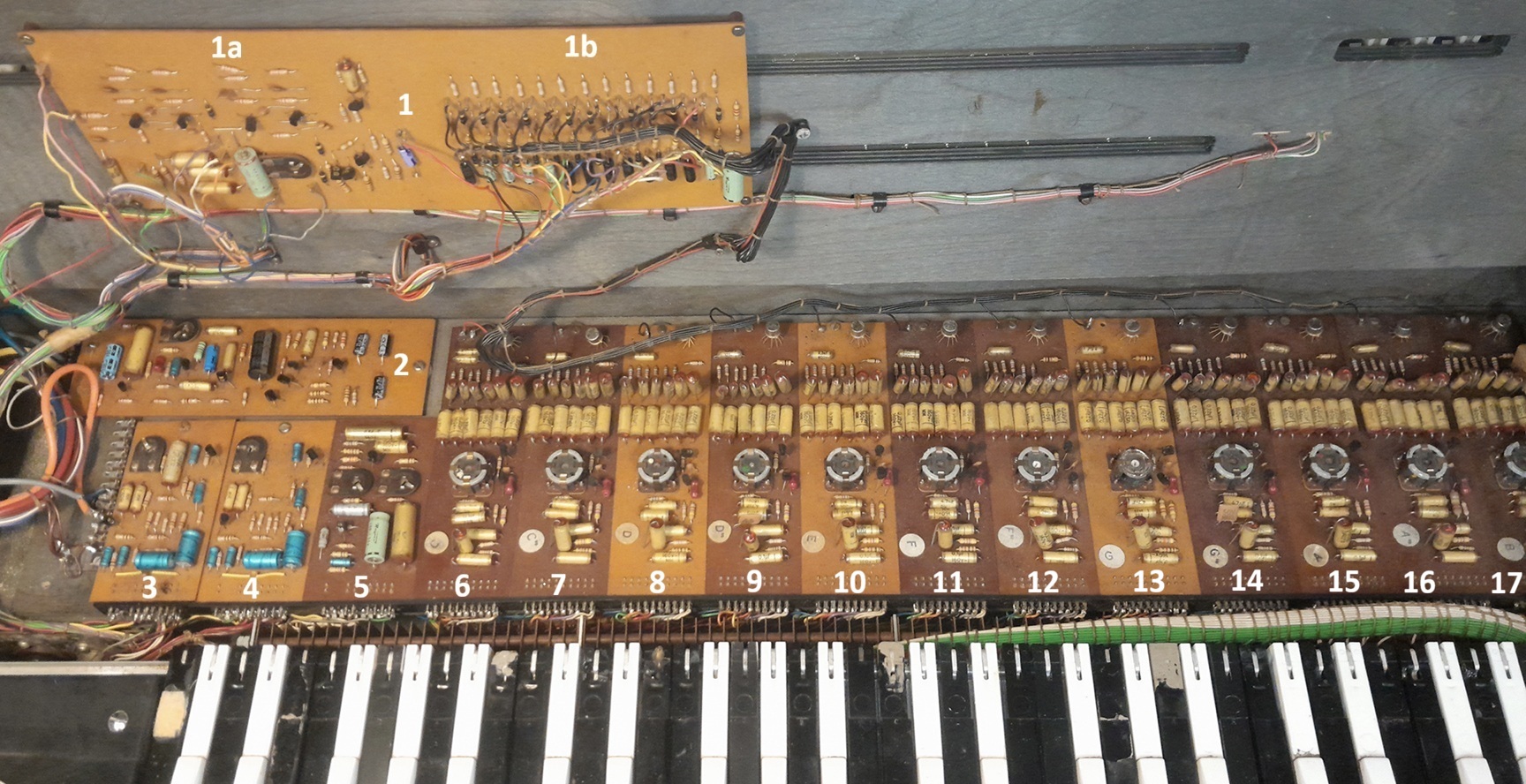
"Under the Hood" - The following legend identifies the function of each of the printed circuit boards of the Continental 300 organ as illustrated above.
Board #1 is described on the Continental 300 schematic ICC/033 as "PCB 60, Walking Bass Unit." It serves two functions. Area #1a is the divider circuit for the 8' and 16' bass tones. Area #1b creates the bass sustain effect. Board #2 houses the reverb drive and return circuit. Board #3 is the preamp for the lower manual while board #4 is the preamp for the upper manual. Board #5 creates the vibrato effect, including two board mounted potentiometers to adjust vibrato depth and speed. Boards #6 through #17 are the tone generator cards, one for each note in an octave.
Price - The August 16, 1970 Vox price list offered the VOX Continental 300 for a retail price of £353 which would convert to about $850 USD in 1970. The optional thirteen note foot pedal board was listed in the same 1970 Vox price list for £26.25 or about $63 USD. Adjusting these 1970 prices for 50+ years of inflation, the Continental 300 would retail today for £6979 or $9,419 USD. The optional foot pedal board would retail today for £519 or $700 USD.
Photo Credit - The Vox Showroom extends its gratitude to Vintage Things in London UK for allowing us to use their photos of the Italian made Continental 300 on this webpage.
|

Additional Resources....
3_Footer

Photos and editorial content courtesy Gary Hahlbeck
Any and all material presented herein is protected by Copyright.
© 1998 - 2026 The Vox Showroom, all rights reserved
The images and editorial content in this web site may not be copied or reproduced
in online auction sites such as eBay, Reverb and Craig's List. Sellers may provide a link
to the Vox Showroom web site if they wish to refer to this copyrighted material.
|
URL: https://www.voxshowroom.com/uk/organ/300.html
|